
Back in 2011, when Warner Bros. announced Anne Hathaway as Catwoman, people had questions. Fair ones, honestly. She was the Princess Diaries girl. The Devil Wears Prada girl. Warm, a little goofy on screen. Selina Kyle is not that. Then The Dark Knight Rises actually came out in July 2012, and most of that skepticism just kind of dissolved. Her Catwoman turned into one of the more talked-about versions the character’s ever gotten.
Over a decade later and people still bring her up. Great comic-book performances, well-designed movie costumes, her name lands in both conversations. Worth actually digging into why. The acting choices, what went into that suit, and how the look is still bleeding into fashion talk that has nothing to do with the film anymore.
Anne Hathaway Catwoman in The Dark Knight Rises
Hathaway played Selina Kyle in the closing chapter of Christopher Nolan’s Batman trilogy. Earlier film versions leaned hard into camp, sometimes straight into fantasy. Not this one, because Nolan’s Gotham never really operated that way to begin with. The whole trilogy ran on a grounded, semi-real-world logic, and Selina got built to fit right into it. Clever. Calculating. Always working an angle. Not villainy for its own sake.
The film frames her as a professional thief chasing something the script literally calls a “clean slate,” a way to wipe her record and actually start over somewhere. That desire sits under basically everything she does. It’s what stops her from flattening into a one-note bad guy. She’s constantly weighing self-interest against something closer to conscience, and honestly, that tension is the whole engine driving her arc.
Why the Performance Actually Landed
A lot of it comes down to restraint. Sounds like a boring word to build a whole performance around, but it’s really the point. Hathaway doesn’t lean on exaggerated body language, doesn’t telegraph “villain” the way a lot of these roles tend to. Most of what she’s communicating happens in the small stuff. A look. A pause before a line lands. Genuinely hard to pull off in a role built entirely around deception, since you need her readable enough for an audience to follow along while the character herself stays believably guarded from everyone around her.
The tonal range helps too. She’ll swing from playful to dangerous, sometimes inside the same scene, and neither register ever feels like a costume she’s slipping into for the moment. Critics at the time also pointed at her chemistry with Christian Bale’s Bruce Wayne, and that works mostly because both of them get written as damaged people first, not a hero paired with the usual love interest.
What’s Actually Going On With Selina, Psychologically
Here’s the part that’s genuinely interesting. Hathaway never plays her as simply good or simply bad. One scene she’s manipulative, guarded, running an angle. The next she looks worn straight down. Both true at once, not one hiding behind the other. That contradiction is really the whole point of the character. Someone who’s spent a long time adapting just to survive, and the film treats that adaptation like an actual psychological cost instead of a personality quirk to gesture at once and move past.
Part of why the character’s aged so well too. You don’t have to agree with her choices to get why she’s making them. And that gap, sympathizing with someone whose actions you probably wouldn’t defend yourself, is a lot of what separates this version from flatter, more straightforwardly heroic or villainous takes on the same character.
The Suit Itself, and Why People Still Talk About It
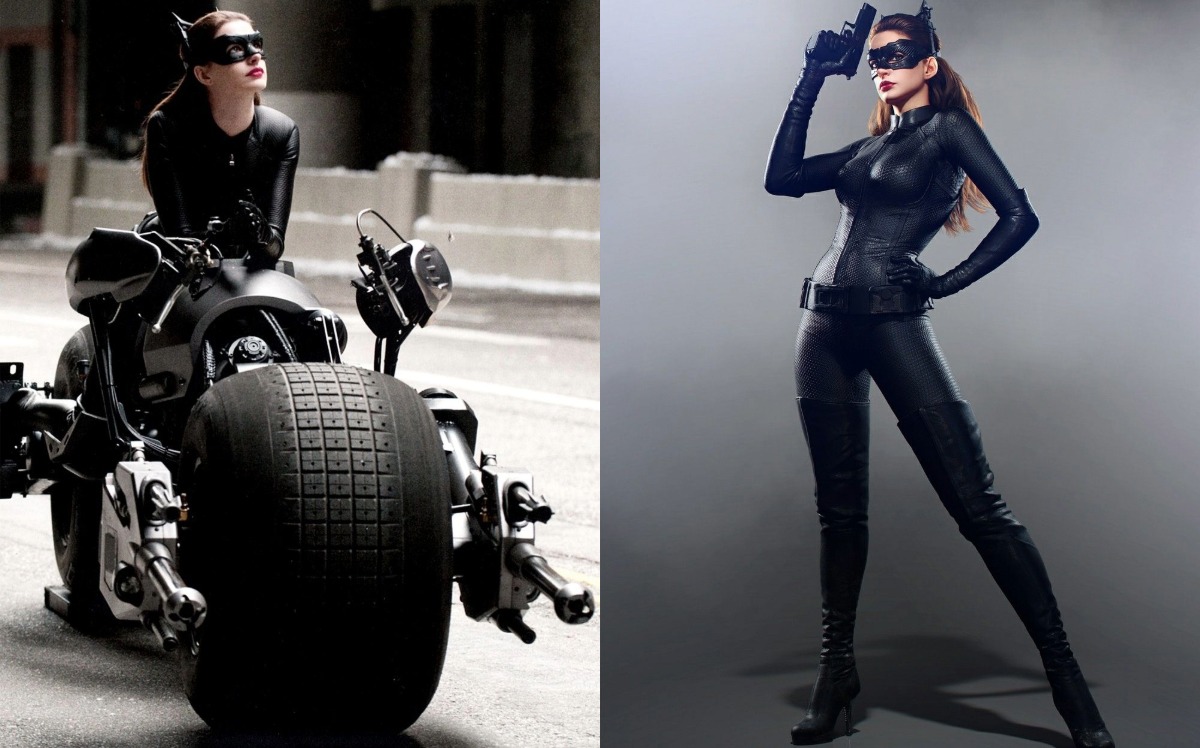
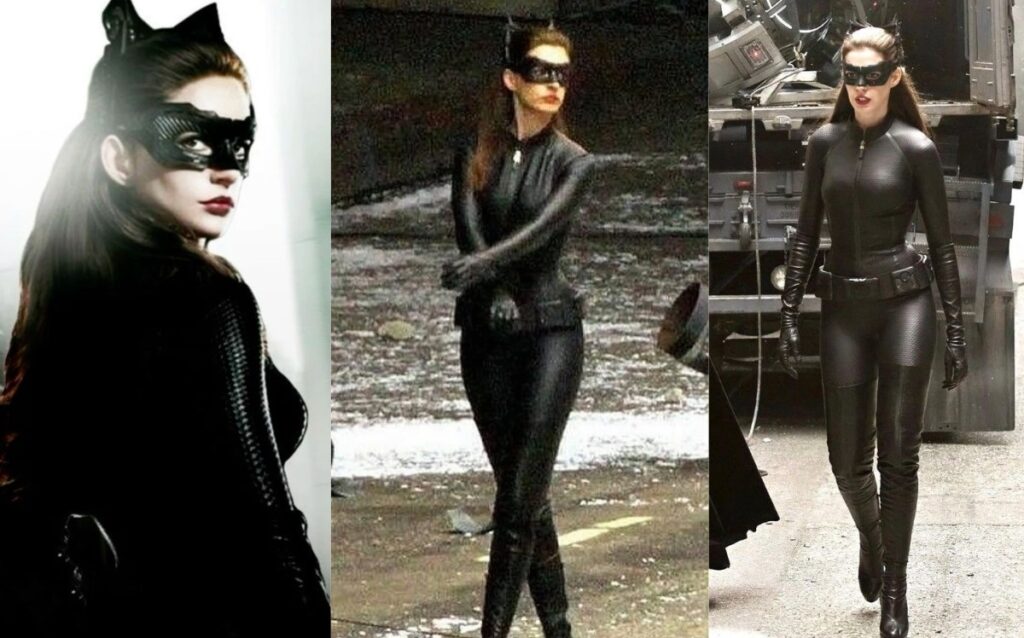
Real credit here goes to costume designer Lindy Hemming, who’d already worked across the Nolan trilogy and brought a genuinely different design approach to Selina than earlier films had bothered with. In interviews around release, Hemming talked about pulling from Thierry Mugler’s silhouettes specifically, aiming for something more structured and pared back than the glossy, overtly sexualized catsuits from previous Catwoman movies. She’s also said the finished suit came out lightweight and breathable rather than the more restrictive builds used before, which mattered a lot given how much of the actual stunt work Hathaway was doing herself.
Visually, they swapped the classic cat-ear silhouette for goggles that flip down into mask-like eye coverings, a detail that lets the film treat Catwoman more like functional gear than a comic-accurate costume. Matte black instead of glossy vinyl or latex, with structured paneling that reads more like real protective equipment than anything fantasy-coded. That grounded quality is exactly what fashion writers and cosplay communities keep pointing back to, since it holds up as an actual wearable design rather than something that only works on a page, kind of the same way a boxy movie-costume jacket can end up outliving the film it was originally built for.
The Training Behind It
Hathaway’s talked fairly openly about how demanding the physical side of this role actually got. A training routine running roughly five days a week, mixing stunt work, dance, general conditioning. She’s put it in blunter terms too at points, saying that just thinking about fitting into the suit basically ate up an entire year of her life, and that she spent around ten months in the gym getting ready for the part.
That level of prep wasn’t only Hathaway pushing herself, either. Nolan reportedly wanted her doing as much of her own stunt work as realistically possible instead of leaning on a double for most of it, and that’s a big part of why her action sequences read as fluid on screen rather than obviously stitched together after the fact.
Catwoman and Batman, A Different Kind of Pairing
The relationship between Selina and Bruce Wayne is one of the more carefully handled parts of the whole film. It builds slowly, more on mutual damage and cautious trust than any conventional romantic setup, and that slower pace is a big reason it actually lands. Both of them are isolated in their own ways, and their connection plays out like two people circling each other warily rather than dropping into an obvious, expected pairing.
Instead of settling into simple romance, it moves through real betrayal and reconciliation before ending up somewhere that feels earned rather than assumed. Meaningfully different approach than a lot of hero-and-love-interest arcs bother taking, and critics at the time called it out as one of the film’s stronger threads.
How the Look Keeps Showing Up in Fashion
More than ten years out, pieces of this costume keep resurfacing in fashion conversations that have absolutely nothing to do with the movie anymore. Structured black leather. Fitted moto jackets. Matte finishes over glossy ones. Minimal hardware instead of piling on embellishment. All of it traces back, in some way, to the visual language Hemming built for this version of the character. It’s turned into a real reference point whenever style writers get into tactical-inspired outerwear or restrained, monochrome leather looks, and it’s a big part of why the structured leather jacket has stayed such a wardrobe staple long after the film left theaters.
Part of why the influence stuck around is that the costume was never really chasing a trend to begin with. It leaned on clean lines and function over decoration, and that’s exactly the kind of design that tends to age well instead of looking dated a few years later. Cosplay communities specifically still treat this costume as one of the harder, more satisfying builds to actually pull off, precisely because the details are so grounded and specific rather than exaggerated for effect.
Where This Leaves the Legacy
Looking back, this performance genuinely shifted how female characters get handled in comic-book films, proving one could be physically capable, funny, and emotionally messy all at once without any of those traits canceling the others out. Big part of why she still gets brought up in conversations about the strongest comic-book performances on record, well outside anything Catwoman-specific.
Between the physical commitment Hathaway put into it, the psychological nuance she brought to Selina, and a costume built on genuinely thoughtful design instead of spectacle, this version of the character has held up in a way a lot of superhero portrayals from the same era simply haven’t. Not just a performance people remember fondly. Something actors and costume designers are still quietly working from.
FAQs
Who played Catwoman in The Dark Knight Rises?
Anne Hathaway played Selina Kyle, also known as Catwoman, in the 2012 film.
Why is Anne Hathaway’s Catwoman so popular?
Fans love her performance because it feels stylish, realistic, intelligent, and emotionally balanced.
Did Anne Hathaway perform her own stunts?
Yes, she trained extensively and completed many action scenes herself.
What made Anne Hathaway’s Catwoman outfit iconic?
The sleek black leather design combined fashion, realism, and practicality perfectly.
Is Anne Hathaway considered one of the best Catwomen?
Yes, many fans and critics consider her one of the strongest modern portrayals of Catwoman.
