

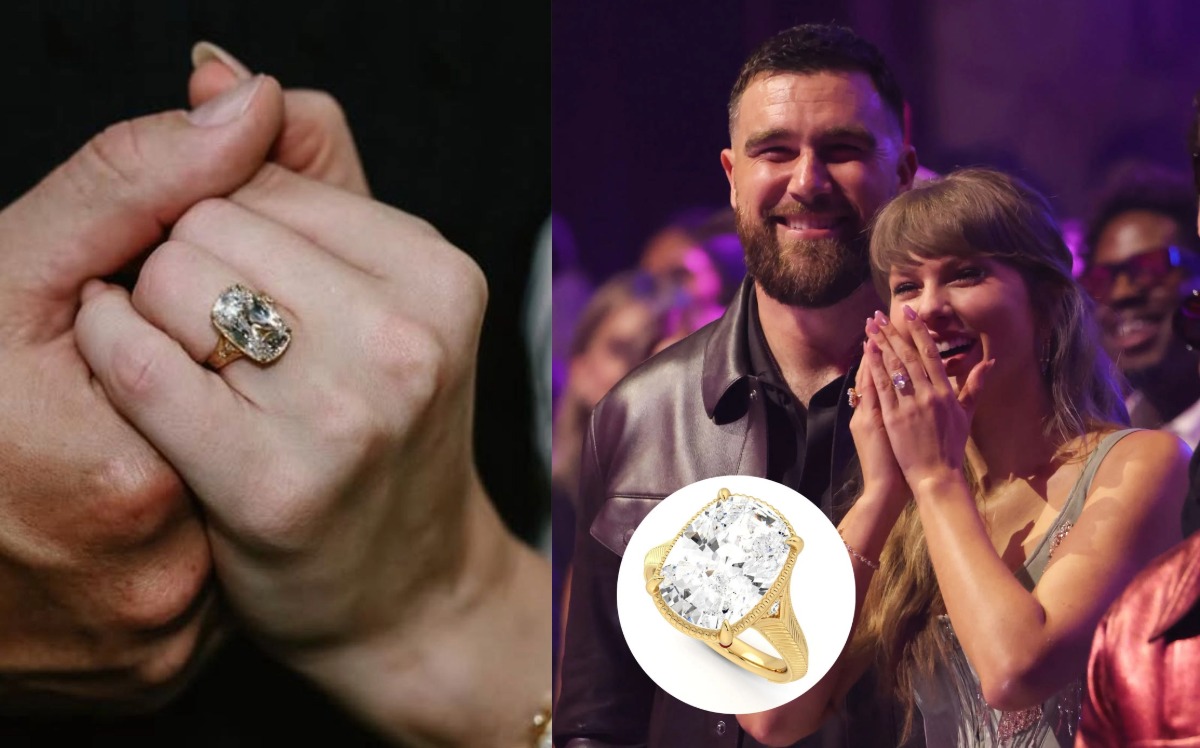
Taylor Swift and Travis Kelce announced their engagement on August 26, 2025, with a five photo Instagram carousel, and by the third photo, a close up of the ring, most of the internet had stopped looking at anything else. Jewelry experts started weighing in within hours. So did Swifties, who are unusually good at this kind of forensic work.
Here’s what’s actually known. The ring is an old mine brilliant cut diamond, hand engraved, set in yellow gold, made by a New York goldsmith named Kindred Lubeck who most people had never heard of before that morning. What’s not known, and probably never will be with any precision, is exactly how big the stone is or what it cost. Nobody involved has said. Everything you’ve seen floating around about “10 carats” or “a million dollars” traces back to jewelers looking at the same handful of photographs and arriving at different conclusions, sometimes wildly different ones. That gap is worth understanding on its own rather than glossing over.
The Story Behind the Ring
Swift’s team confirmed the basics through her publicist, Tree Paine, who told reporters the stone is an old mine brilliant cut. That was more or less it. No carat weight, no price, no further comment. The rest of the story came out gradually, mostly from Swift herself.
In an interview with the UK radio show Heart Breakfast, she explained that she’d shown Kelce a video of Lubeck’s work about a year and a half before the proposal, without expecting him to remember it. He did. When she finally saw the finished ring, she recognized the hand engraving instantly, and she’s said she reacted with something close to disbelief that he’d actually paid attention that whole time. Kelce didn’t just buy the ring off a shelf. He worked with Lubeck directly on the design. That detail is a big part of why the ring reads as personal rather than as a standard, if expensive, jewelry store purchase.
What the Ring Actually Looks Like
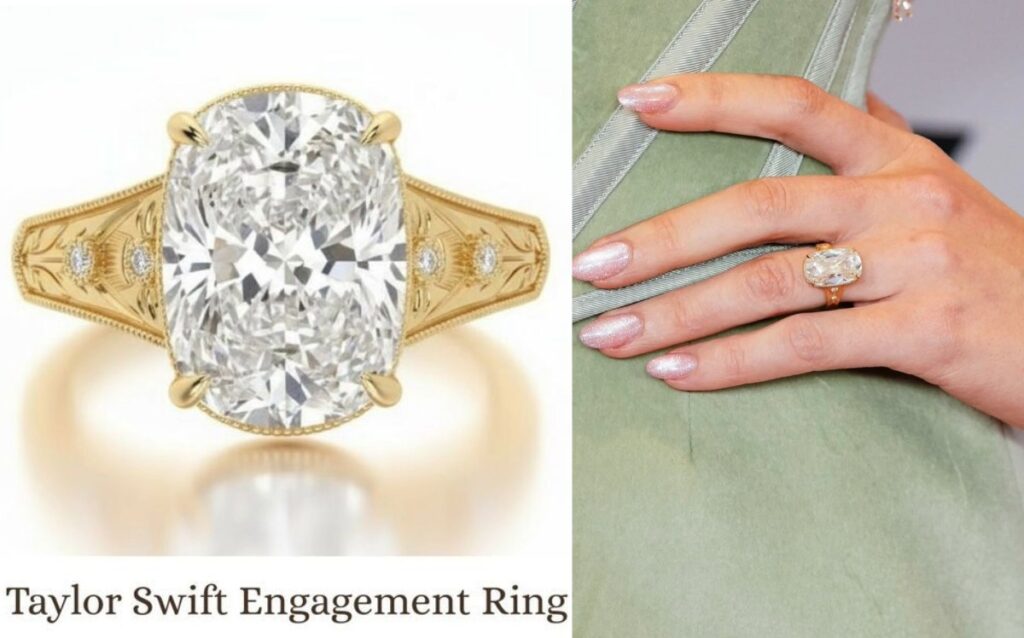
The center stone is an old mine brilliant cut, a style that predates the modern round brilliant by well over a century. Old mine cuts tend to be a little boxy, with rounded corners and facets that aren’t machine perfect the way today’s diamonds are. Several jewelers who studied the engagement photos described Swift’s stone more specifically as an elongated antique cushion, a rarer variation that reads longer and more dramatic than a standard cushion cut of the same weight.
It’s set in 18 karat yellow gold, in what most experts describe as a bezel or collet style mount (the metal wraps around the stone rather than lifting it up on tall prongs), sometimes paired with small corner prongs and what jewelers call a button back underneath. The band carries Lubeck’s signature hand engraving, and some accounts mention filigree detailing along the shoulders. Put together, none of it looks like a typical celebrity engagement ring. Most of those are round or cushion diamonds in platinum or white gold, cut for maximum uniform sparkle. Swift’s leans the other way entirely: warmer, less symmetrical, closer to something you’d find in an estate sale than a display case, which is exactly the appeal for people who collect antique jewelry.
How Big Is It, Really?
Here’s the honest answer. Nobody outside Swift’s circle has actually measured it, so every number you’ve read is a guess based on photographs.
TODAY.com’s in house experts put it around 7 to 8 carats. A jeweler consulted by Fortune landed close to 8. InStyle’s sources have generally run higher, in the 8 to 10 range, and by the time the ring made its red carpet debut, InStyle’s own headlines had settled on calling it a “10 carat” ring. On the far end, an appraiser who spoke to Forbes floated 13 carats, noting, half seriously, that the number lines up with Swift’s well documented affection for 13, while also being clear that a confident read just isn’t possible from Instagram photos.
So the honest range is probably somewhere in the high single digits to low double digits, with 8 to 10 carats being what most experts converge on. It’s still not confirmed. It’s also worth remembering that the elongated cushion shape and the low, close set bezel mounting both make a stone look bigger than its raw weight would suggest, which is part of why the ring photographs as so much larger than life even at the more conservative estimates.
What’s It Worth?
If the carat estimates are scattered, the price estimates are scattered even further, because price depends on more than size alone. Several jewelers consulted by TODAY.com and other outlets put the ring somewhere between $400,000 and $1.2 million. InStyle’s sourcing lands around $500,000 to $1 million. Forbes’ appraiser estimated roughly $650,000, assuming top color and clarity grades. A few outlets have cited figures as high as $2 million, and one report attributed an outlier estimate, reportedly from People, as high as $5 million.
None of that is confirmed, and the spread is wide enough that treating any single figure as “the” price would be misleading. It’s not that anyone’s guessing carelessly. Carat weight is just the starting point. Color, clarity, cut quality, and how well matched the stone’s proportions are all move the number, and antique cuts are genuinely harder to grade from a photo than modern diamonds, because they don’t follow standardized modern proportions. Then there’s everything outside the stone itself: the bespoke gold work, the hand engraving, Lubeck’s design fee. None of that shows up in a simple per carat calculation.
Who Made It
The ring was designed by Kindred Lubeck, a New York goldsmith who founded Artifex Fine Jewelry around 2023. She comes by the trade honestly. Her father, Jay Lubeck, has run a goldsmith shop in Neptune Beach, Florida, since the 1970s. Before Swift’s engagement, Lubeck had built a small but growing reputation for hand engraved gold work and antique cut stones. Afterward, she’s described the experience as surreal, saying in interviews that she barely slept once she learned whose ring she was making.
The pairing makes sense once you look at her other work. Lubeck’s pieces consistently favor antique stones, warm gold tones, and detailed hand engraving over the polished, standardized look of most fine jewelry, which lines up closely with Swift’s well known taste for vintage style in her wardrobe and elsewhere. And it wasn’t a coincidence that Swift recognized the ring on sight. She’d been a fan of Lubeck’s work before Kelce ever started designing with her, which is what turns this from a good jewelry choice into a genuinely personal one.
The Red Carpet Debut
Swift didn’t wear the ring in public at an event for months. That changed on March 26, 2026, at the iHeartRadio Music Awards at the Dolby Theatre in Los Angeles, her first awards show appearance since the engagement and the first the couple attended together. She wore a mint green velvet corset and miniskirt by Wiederhoeft, picked up seven awards including her third consecutive Artist of the Year win, and the ring was visible in nearly every photo from the night.
Under red carpet lighting, the warm yellow gold and the elongated stone shape photographed distinctly against the pale outfit, which made close up shots easy to isolate. A few outlets noted she’d paired the moment with a bridal toned manicure, which did nothing to slow down wedding speculation.
The Old Mine Diamond Trend It Helped Fuel
Old mine cuts date back to the 18th and 19th centuries, cut and polished entirely by hand before modern equipment existed. They typically have around 58 facets, a somewhat squared outline with rounded corners, and a softer, warmer glow than a modern round brilliant, designed originally to catch candlelight rather than the artificial lighting standards jewelers cut for today.
| Feature | Old Mine Cut | Modern Brilliant |
| Look | Vintage, individual character | Highly standardized |
| Cutting era | 18th to 19th century, hand cut | Modern, machine precision |
| Facet symmetry | Uneven, by hand | Precisely calibrated |
| Sparkle | Softer, warmer | Maximum brightness |
Interest in antique and vintage cut stones was already rising before Swift’s engagement, but several jewelers have told Vogue and other outlets that her ring accelerated it considerably. That’s not just talk, either. A few months after the engagement, Sotheby’s partnered directly with Lubeck on a limited “Gem Drop” auction of hand engraved, antique cut rings, including another old mine piece, which ran in November 2025 with a follow up sale that December. An independent jeweler landing an auction house partnership within months of her first major commission says something real about how far this particular ring’s visibility traveled.
Why It’s Worth What It’s Worth
Strip away the carat guessing and the dollar figures, and a few things genuinely set this ring apart. Antique cut diamonds this size are uncommon to begin with. Most old mine stones still in circulation are considerably smaller. The hand engraving and custom gold work add value that a mass produced setting simply wouldn’t carry. Kelce worked with Lubeck on the design rather than buying something off an existing line, which makes it one of one. And Lubeck’s subsequent recognition, including the Sotheby’s partnership, has arguably raised the cultural weight of owning an original Artifex piece beyond what the diamond alone would justify.
Frequently Asked Questions
How many carats is Taylor Swift’s engagement ring?
Expert estimates range from about 7 to 13 carats, with 8 to 10 carats being the range most commonly cited. The exact weight has never been officially confirmed.
How much is Taylor Swift’s engagement ring worth?
Estimates vary widely. Most fall between $400,000 and $1 million, with a few outlier guesses reaching $2 million or more. No price has been officially disclosed.
Who made Taylor Swift’s engagement ring?
Kindred Lubeck, founder of Artifex Fine Jewelry in New York, designed the ring in collaboration with Travis Kelce.
What type of diamond is Taylor Swift’s engagement ring?
An old mine brilliant cut, described by several experts as an elongated antique cushion shape, set in 18 karat yellow gold.
Did Travis Kelce help design Taylor Swift’s engagement ring?
Yes. He worked directly with Kindred Lubeck, reportedly inspired by a video of her work that Swift had shown him about a year and a half before the proposal.
The Bigger Picture
The part of this story that holds up isn’t the size or the price tag, even though those are what most people are actually searching for. It’s that the pieces that can be verified, the old mine cut, the hand engraving, the choice of a designer Swift had admired long before the proposal, tell a more specific story than most celebrity engagement news does. The carat weight and the valuation will likely stay unsettled forever, guessed at by different experts working off the same few photos. But the ring itself, and the collaboration behind it, have already changed how people are shopping for antique diamonds, which is a stranger and more lasting kind of impact than any single number could capture.
